If you’re planning to drill a water well, one of the first questions you’ll ask is, “How much is this going to cost?”
It’s a fair question, but after years in the industry I’ve learned that there’s no single number that applies to every property. I’ve seen straightforward wells completed quickly and affordably, and I’ve seen projects where unexpected geology turned a routine installation into a much larger investment.
The biggest mistake homeowners make is treating well drilling like installing a utility connection. It isn’t. Every project is different because no one truly knows what lies beneath the ground until the drilling begins. Looking for a water well drilling company in Southern Oregon with over 100 years of drilling experience? Call Enloe Drilling and Pumps today
Understanding what influences the final cost will help you budget realistically and avoid unpleasant surprises.
Read our latest blog: How Deep Does a Water Well Need to Be?
What Does It Cost to Drill a Water Well?
Based on the projects I’ve worked on over the years, here’s what homeowners can generally expect.
Typical Residential Well
Most standard residential water wells fall between $5,500 and $8,500.
This usually applies when:
- The property is easy to access.
- The drilling rig can work without obstacles.
- Water is found at around 150 feet.
- The ground consists of manageable soil and rock formations.
- Standard PVC casing and a conventional submersible pump are sufficient.
These projects are often completed within one or two days without major complications.
Best-Case Scenario
Some properties have almost perfect conditions.
I’ve seen wells completed for $2,000 to $3,500 when:
- The water table is shallow.
- Water is found within 40 to 50 feet.
- The ground consists of sand, gravel or soft soil.
- Minimal casing is required.
- A simple jet pump is suitable.
These are the exception rather than the rule, but they do happen.
Worst-Case Scenario
On the opposite end of the spectrum, I’ve also worked on projects costing $25,000 to $45,000 or more.
These are the jobs every experienced driller remembers.
They usually involve several expensive challenges happening at the same time, including:
- Extremely hard granite or basalt.
- Water only being found beyond 600 feet.
- Difficult mountain or heavily wooded access.
- Collapsing soil requiring extensive steel casing.
- Large, high-powered pumps.
- Water treatment systems because of poor water quality.
When multiple complications occur together, costs increase rapidly.
read our latest Blog: How to Find a Reliable Water Well Drilling Company Near Me
The Three Biggest Factors That Affect Well Drilling Costs
Many homeowners ask why one neighbour paid half the price of another.
In my experience, it almost always comes down to three factors.
1. Drilling Depth
Everything in well drilling is based on linear footage.
If the depth doubles, so does much of the work involved.
A deeper well means:
- More drilling time.
- More casing.
- More electrical cable.
- More drop pipe.
- A larger pump capable of lifting water from greater depths.
Depth alone can dramatically change the overall project cost.
2. Rock Hardness
Not all underground formations drill at the same speed.
Soft sandstone or limestone allows steady progress.
Granite and quartz are a completely different story.
I’ve seen drill bits that normally advance around 30 feet per hour slow to only a few feet per hour when encountering extremely hard rock. The equipment takes significantly more wear, drill bits require replacement, and labour hours increase accordingly.
3. Unstable Ground
Collapsing formations can become one of the most expensive parts of a project.
Loose gravel, sand and unstable soils often collapse back into the borehole while drilling.
When this happens, crews may need to install heavy steel casing during drilling simply to prevent the hole from collapsing.
That adds both material costs and additional labour.
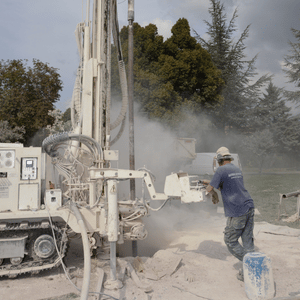
The Biggest Misconception About Water Well Costs
The biggest misunderstanding I see is what I call the “plug-and-play” myth.
Many homeowners assume drilling a water well works like connecting to municipal water.
They expect a fixed price and a guaranteed outcome.
That simply isn’t how well drilling works.
We’re performing geological exploration.
Until the drill reaches the underground formations, nobody knows exactly what will be encountered.
That’s why reputable contractors estimate costs based on local experience but charge according to the actual work required.
Why You Can Never Compare Quotes on Price Alone
One mistake I regularly see is homeowners choosing the cheapest quote without comparing what is actually included.
Some contractors only quote for drilling the hole itself.
Everything else becomes an additional charge.
A complete quotation should clearly include:
- Well casing.
- Well screen.
- Submersible pump.
- Drop pipe.
- Electrical wiring.
- Pressure tank.
- Control equipment.
- Sanitary well cap.
- Excavation and trenching where applicable.
The cheapest quote often becomes the most expensive project once all the missing components are added.
A Real Project That Changed Everything
One project has stayed with me because it perfectly illustrates why no one can guarantee final drilling costs.
A homeowner was building on a scenic ridge.
Their neighbour, only about 150 yards away, had reached excellent water at roughly 160 feet.
Based on local information, we estimated drilling to approximately 180 feet.
The expected total project cost was around $6,200.
Everything went smoothly until about 40 feet.
Then we encountered an unexpected granite shelf sitting above loose gravel.
Progress slowed dramatically.
Instead of advancing quickly, the rig was crawling through solid rock.
Every time we broke into the gravel beneath the granite, the hole began collapsing around the drill string.
At 200 feet we still hadn’t found water.
We stopped work and sat down with the homeowner to explain the situation.
They had two choices.
They could abandon the dry hole and start again elsewhere, or continue drilling using expensive threaded steel casing to stabilise the collapsing ground.
Rather than simply explaining the problem, I showed them exactly what was coming out of the borehole.
They could see the crushed granite, the loose gravel and the conditions we were dealing with underground.
Once they saw the geology for themselves, they understood why the project had changed so dramatically.
We continued drilling.
Water was finally located at approximately 460 feet, producing an excellent yield of around 12 gallons per minute.
By the time the project was complete, it required:
- Nearly three times the expected drilling depth.
- Hundreds of feet of heavy steel casing.
- A powerful multi-stage 3 HP submersible pump.
The final investment was approximately $19,400.
The lesson is simple.
Your neighbour’s well tells you very little about what lies beneath your own property.
Underground geology can change dramatically over surprisingly short distances.
How Homeowners Can Reduce Their Well Drilling Costs
Although nobody can control geology, there are several ways to avoid unnecessary expenses.
Create Proper Access
A drilling rig is an enormous piece of equipment.
Before it arrives:
- Remove low tree branches.
- Provide adequate width for access.
- Ensure there is enough room for the rig to level and operate safely.
Good access reduces delays and avoids expensive standby charges.
Position the Well Carefully
Many homeowners want the well hidden at the far end of the property.
That often increases costs unnecessarily.
Every extra metre between the well and the house requires additional trenching, electrical cable and water pipe.
Positioning the well as close to the home as local regulations allow can save thousands of dollars.
Invest in a Hydrogeological Survey
One of the smartest investments you can make is hiring a hydrogeologist before drilling.
Rather than guessing based on nearby wells, they analyse geological data, terrain and underground formations to identify the most promising drilling locations.
If that survey reduces your drilling depth significantly, it can pay for itself many times over.
Consider a Shared Well
Where local regulations permit, neighbouring properties can sometimes share a single high-yield well.
This spreads installation costs between multiple owners and reduces long-term operating expenses.
Mark Underground Services
Always identify:
- Septic systems.
- Irrigation lines.
- Private electrical cables.
- Underground plumbing.
Preventing accidental damage before drilling begins is far less expensive than repairing broken infrastructure afterwards.
My Biggest Advice Before You Drill a Water Well
If I could give every homeowner one piece of advice, it would be this:
Never assume your neighbour’s well determines what will happen on your property.
The second piece of advice is equally important.
Never budget only for the estimate.
Well drilling isn’t like installing an appliance.
You’re paying for skilled professionals to explore underground conditions that nobody can see beforehand.
Most projects go according to plan.
Some don’t.
That’s why I always recommend maintaining a contingency fund of at least 50% above the estimated drilling cost.
If your estimate is $8,000, make sure you have access to roughly $12,000 to $14,000.
If everything goes smoothly, that money can be used elsewhere on your property.
If unexpected geology appears, you’ll be able to complete the project rather than being left with a partially drilled hole and no water supply.
In my experience, homeowners who understand this before drilling begins enjoy a much smoother process. They know what they’re investing in, they’re prepared for unexpected conditions, and they can make informed decisions if geology throws a surprise their way. That’s the mindset that leads to the best outcomes and far fewer unpleasant surprises.