
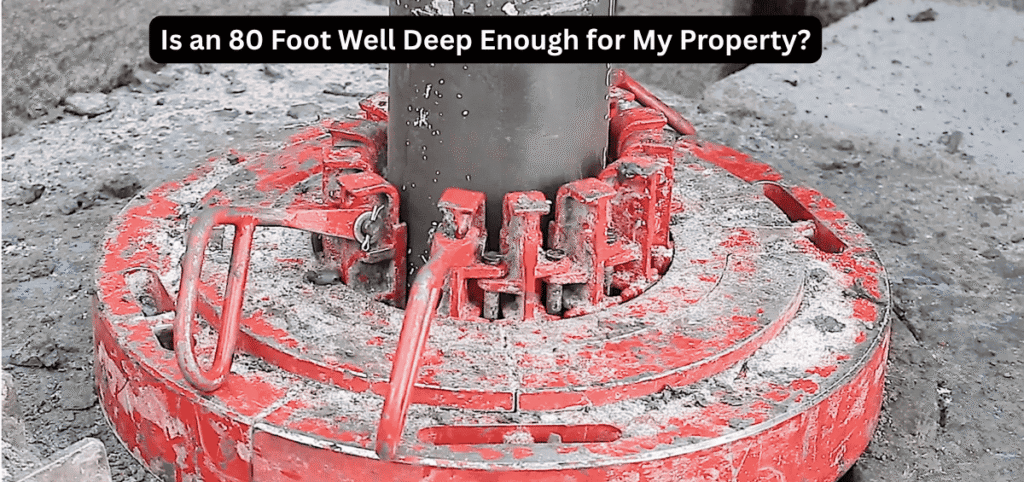
One of the most common questions I hear from homeowners is, “Is an 80-foot well deep enough for my property?”
My answer usually surprises them.
An 80-foot well is neither good nor bad.
It’s simply a number.
The biggest misconception homeowners have is believing they can choose how deep their well will be based on their budget. Unfortunately, the earth doesn’t work that way.
I’ve always believed that you don’t choose the depth of your well. The geology beneath your property chooses it for you.
Before you decide that 80 feet is enough, here’s what you need to understand. For all your well drilling needs contact Enloe Drilling and Pumps
Why Homeowners Become Fixated on 80 Feet
Most homeowners arrive at a specific drilling depth for one of three reasons.
- A neighbor’s well is around 80 feet deep.
- Someone told them that’s the average depth in the area.
- That’s all their budget allows.
None of these reasons have anything to do with the geology beneath your property.
Underground water doesn’t flow through one giant underground lake.
It moves through sand, gravel, porous limestone, fractures in granite, and countless geological formations that can change dramatically within just a few hundred feet.
Your neighbor’s well might produce excellent water at 80 feet while your property requires drilling well beyond 300 feet.
A Real Project That Changed a Homeowner’s Perspective
A few years ago, a homeowner purchased five acres in the foothills of Virginia’s Blue Ridge Mountains.
Before contacting a driller, he spoke with a neighbor whose well had been drilled to approximately 75 feet during the 1970s.
Based on that single conversation, he budgeted for an 80-foot well.
He believed anything deeper meant the contractor was simply increasing the bill.
What We Found Underground
The two properties looked similar above ground.
Underground, they couldn’t have been more different.
The neighbor’s home sat near a creek on a shallow alluvial deposit.
The new property was positioned several hundred yards away on higher ground where a thin layer of soil covered dense granite bedrock.
The drill rig reached granite at approximately 25 feet.
By the time we reached 80 feet, the drill was still cutting through solid, dry granite.
There wasn’t enough water to support a residential well.
The Final Result
Stopping at 80 feet would have left the homeowner with an expensive hole in the ground and no usable water.
Instead, we continued drilling.
At approximately 340 feet, we finally intercepted productive water-bearing fractures.
The completed well produced around 20 liters per minute, providing a dependable long-term water supply.
The lesson couldn’t have been clearer.
You don’t dictate well depth.
The geology does.
When Is an 80-Foot Well Actually Deep Enough?
Despite what many people believe, there are situations where an 80-foot well is perfectly adequate.
The key is understanding the geology beneath your property.
Properties Where 80 Feet May Be Enough
Shallower wells often perform very well in areas with naturally high groundwater tables.
Examples include:
- River valleys with thick sand and gravel deposits.
- Floodplains containing highly permeable soils.
- Coastal plains with shallow limestone aquifers.
- Glacial deposits common throughout parts of the Midwest.
These formations allow groundwater to move freely and recharge quickly.
In these situations, drilling much deeper may provide little additional benefit.
When 80 Feet Usually Isn’t Enough
Other geological settings tell a completely different story.
If I arrive on a property with any of the following conditions, I’m already preparing the homeowner for a deeper well.
- Solid granite or crystalline bedrock.
- Heavy clay soils.
- Mountainous terrain.
- High-elevation building sites.
- Arid climates with deep regional water tables.
In these environments, groundwater usually travels through deep fractures rather than shallow porous layers.
Finding reliable water requires patience and sometimes significantly greater drilling depth.
How Experienced Drillers Predict Well Depth Before Drilling
Before the drilling rig even unloads, I’m already studying the property.
Experienced drillers don’t guess.
We gather clues.
Topography
One of the first things I evaluate is elevation.
- Properties located in valleys often have shallower groundwater.
- Homes built on ridges usually require deeper drilling.
Vegetation
The surrounding plant life often tells an important story.
- Healthy hardwood trees and lush vegetation often indicate shallow groundwater.
- Sparse vegetation and drought-tolerant species usually suggest drier upper soils.
Rock Outcrops
Visible granite or limestone outcrops tell me bedrock sits close to the surface.
That immediately changes my expectations for drilling depth.
Nearby Well Logs
One of the most valuable tools available is the state’s public well log database.
These records reveal:
- Nearby well depths.
- Rock formations.
- Water yields.
- Casing depths.
They’re often far more valuable than a neighbor’s opinion.
Why Stopping at 80 Feet Can Ruin an Otherwise Successful Well
One project perfectly demonstrates why chasing an arbitrary drilling depth is dangerous.
A homeowner hired a dowser who confidently claimed there was a massive underground water stream approximately 60 feet below the property.
The homeowner instructed the crew to stop drilling at 80 feet if water hadn’t been found.
He believed every additional foot was simply increasing the bill.
Read our latest blog post: How Long Does It Take to Drill a Water Well?
What Happened at 80 Feet?
At 80 feet, the drill was still cutting through dry limestone.
The compressor was blowing nothing but dry rock dust from the hole.
There was no usable water.
Stopping there would have created a completely useless dry well.
Why We Recommended Going Deeper
Years of experience told us something important.
Limestone often stores groundwater within deep fractures and underground solution channels rather than throughout the rock itself.
We believed the productive formation was still below us.
After discussing the geology with the homeowner, he reluctantly agreed to continue drilling.
The Turning Point
At approximately 145 feet, everything changed.
The drill string suddenly dropped into a limestone fracture.
The dry rock dust instantly became muddy water.
Moments later, crystal-clear groundwater surged from the borehole.
Testing confirmed an exceptional production rate of approximately 35 gallons per minute.
For perspective, many residential homes require only around 5 gallons per minute.
The additional drilling transformed what would have been a failed project into a lifetime water supply.
The Biggest Myth About Well Depth
One belief frustrates experienced drillers more than almost anything else.
“Once you hit water, stop drilling.”
On the surface, it sounds logical.
Unfortunately, it’s usually the wrong decision.
Finding Water Isn’t the Same as Building a Reliable Well
The first water you encounter is often the very top of a water-bearing zone.
That doesn’t mean you’ve created a dependable well.
I like to explain it using a simple analogy.
Imagine drinking through a straw.
If the straw barely touches the water, you’ll get one sip before sucking air.
Push the straw deeper into the glass and you have access to the entire volume of water.
Drilling deeper works the same way.
Additional depth creates a storage reservoir beneath your pump, allowing the well to continue producing during heavy household demand.
Seasonal Water Levels Matter
Groundwater rises and falls throughout the year.
A well that performs perfectly during spring may struggle during a dry summer if it wasn’t drilled deep enough.
Stopping the moment water appears often leaves homeowners vulnerable during drought conditions.
A Costly Lesson
I once worked with a homeowner who insisted on stopping at approximately 90 feet after finding a small water-bearing fracture producing around 2 gallons per minute.
He wanted to save money.
Several months later, the water table dropped during summer.
The shallow fracture became clogged with silt.
The well went completely dry.
The homeowner had to pay thousands of dollars just to remobilize the drilling rig and continue drilling.
If we’d drilled another 40 feet during the original project, it would have cost a fraction of the price.
Should You Plan for a Deeper Well?
The answer depends entirely on your property’s geology.
Instead of asking:
“Can I get away with an 80-foot well?”
Ask:
“What depth gives me the best chance of having reliable water for the next 30 years?”
That’s a far better question.
Final Thoughts
Looking back over my career, the biggest lesson I’ve learned about well depth is simple.
You do not choose the depth of your well. The geology beneath your property chooses it for you.
If you remember only one thing from this article, let it be this:
An 80-foot well is neither inherently good nor bad. It’s simply a number.
Don’t chase a specific depth because that’s what worked for a neighbor or because it fits neatly into your budget.
Underground water follows its own unpredictable paths through sand, gravel, limestone, and deep rock fractures.
When you hire an experienced well driller, you aren’t paying them to manufacture water at the depth you prefer.
You’re paying them to safely manage specialized equipment while interpreting the hidden geology beneath your feet.
Approach your project with a realistic budget, trust the geological evidence, and allow the drilling depth to be determined by what the earth reveals.
That’s how you end up with a dependable, high-yield water supply that will serve your family for decades rather than a dry hole that costs even more to fix later.