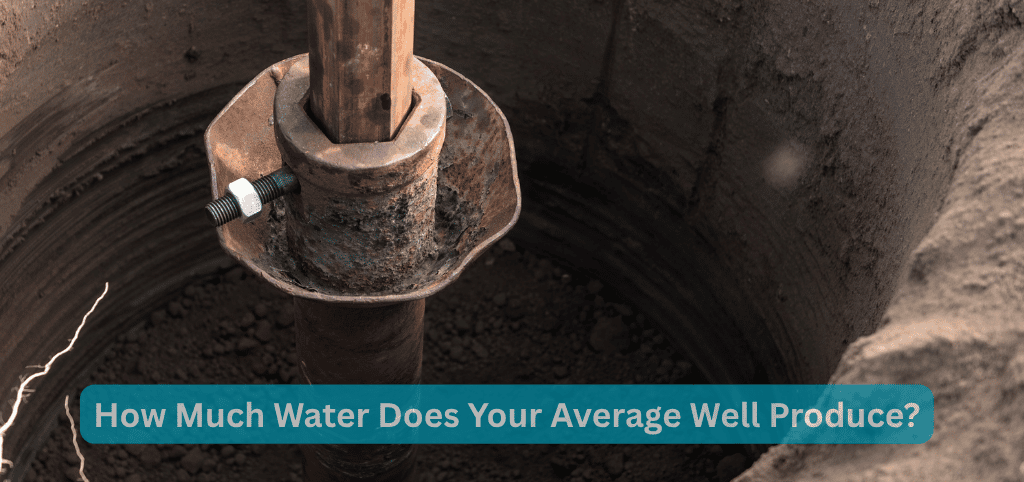
In our regional experience at Enloe Drilling & Pumps Inc., residential wells commonly produce around 5 to 15 gallons per minute, or GPM. However, this is a practical range from our experience, not a guaranteed output or a statistical average for every property in Southern Oregon and Northern California.
Some wells produce considerably more. Others deliver only 1 to 3 GPM and need carefully designed storage and pumping equipment to meet household demand.
The most useful question is not simply, “How much does the average well produce?” It is, “How much water can my well reliably supply, and will that meet my household’s needs during the dry season?”
What Does Well Production Mean?
Well production describes the rate at which a well can supply water under particular pumping conditions. It is usually expressed in gallons per minute.
However, the water flowing from your faucet is not necessarily a direct measurement of the well’s sustainable yield. Your pump, pressure tank, plumbing, and any water stored in the well all influence what you see at the tap. For all your well drilling needs contact us TODAY
Well Yield and Pump Output Are Different
A pump capable of delivering 10 GPM does not prove that the surrounding groundwater formation can continuously supply 10 GPM. For a while, the pump may draw on water already stored inside the well.
To understand reliable production, a contractor needs to assess the pumping rate alongside changes in the water level and the well’s recovery after pumping stops.
This distinction matters when buying rural property, selecting a pump, or planning irrigation. A strong flow for a few minutes can give an incomplete picture of the available water supply.
Read our latest blog post: How Much Does Well Water Testing Cost?
Why Well Production Varies Across Southern Oregon and Northern California
Our service area includes valley sediments, volcanic formations, and mountainous terrain. These conditions affect how groundwater is stored and how easily it moves into a well.
In fractured rock, production often depends on whether drilling intersects water-bearing fractures with sufficient recharge. In sand and gravel formations, the thickness and permeability of the water-bearing layers can strongly influence output.
Nearby Wells Offer Clues, Not Guarantees
Two nearby properties can have very different well yields. One well may intersect a productive fracture while another encounters tighter rock with limited water movement.
That is why local well logs are useful when planning a drilling project. They can show recorded depths, geological conditions, water levels, and production figures from surrounding wells.
We recommend treating those records as planning information rather than a promise. Neither a town-wide average nor a neighbor’s successful well can establish the output of your particular property.
How Much Well Water Does a Household Need?
To decide whether a well produces enough water, separate total daily consumption from peak demand. These are different requirements, and both affect system design.
Daily Consumption Is the Total Volume You Use
Your household’s daily water use includes showers, toilets, laundry, cooking, cleaning, and outdoor activities. Family size, fixture efficiency, irrigation, livestock, and leaks all affect the total.
For a simple planning example, suppose a household uses 400 gallons per day. A well sustaining 1 GPM around the clock would theoretically produce 1,440 gallons in 24 hours.
That calculation shows why a low-yield well may still serve a home. However, it assumes the well can maintain that rate continuously. Actual usable capacity must account for tested performance, seasonal conditions, pump controls, and operating limitations.
Peak Demand Is How Quickly You Need Water
Families do not spread their consumption evenly over 24 hours. Demand rises when showers, appliances, and other fixtures operate together.
A household might temporarily need 8 to 12 GPM, depending on its fixtures and usage. A well yielding 1.5 GPM cannot supply that demand indefinitely without drawing on stored water.
This is why a well can provide enough total water each day but still struggle during a busy morning. The solution depends on both the available daily volume and the size and duration of those demand peaks.
Can a Low-Yield Well Supply a Home?
Yes, a low-yield well can sometimes provide a dependable household supply when its sustained production is sufficient for daily use and the system includes appropriate storage.
Our advice is to assess the water balance before assuming that a new well or a larger pump is necessary.
Storage Can Bridge the Gap Between Production and Demand
An atmospheric storage tank allows a well to collect water gradually. A separate booster pump then supplies the house at the required flow and pressure.
A properly designed system may include:
- A well pump selected and controlled for the well’s tested performance.
- A covered storage tank suitable for potable water.
- Tank-level controls that stop filling when the tank is full.
- Dry-run protection to protect the well pump.
- A booster pump and pressure equipment matched to household demand.
- Appropriate sanitary protection and maintenance arrangements.
The tank size should reflect your consumption, peak demand, available refill rate, and desired reserve. A 1,500-gallon tank may suit one property while another needs a different design.
Storage does not create additional groundwater. If you consistently use more than the well produces, the tank will eventually empty.
A Larger Pump Does Not Increase the Well’s Yield
Installing a more powerful pump does not make the aquifer recharge faster. If the pump withdraws water faster than it enters the well, it can lower the water level toward the pump intake.
Depending on the equipment and protection controls, this can interrupt the supply and risk pump damage.
However, low pressure does not automatically mean low well yield. A clogged filter, faulty pressure tank, plumbing leak, or pump problem can cause similar symptoms. Diagnose the system before replacing equipment.
Why a Short Flow Test Can Be Misleading
A bucket test can estimate the flow from a particular outlet. It cannot, by itself, establish how long the well can sustain that flow.
The missing information is often the water level inside the well and how it changes while pumping continues.
Water Stored in the Well Can Mask Limited Recharge
A well contains water below its resting water level. Part of that stored volume may be available for pumping before the water level approaches the pump intake.
If the surrounding formation replenishes water slowly, a short test may end before the stored supply is significantly depleted. The outlet can appear productive even though sustained use would expose a limitation.
This is why we advise homeowners to ask what was measured, how long the test lasted, and whether water-level and recovery observations were recorded.
An Illustrative Example: The 15-Minute Illusion
The following scenario illustrates the difference between short-term flow and sustained production. It is not a documented Enloe customer project.
A rural buyer watches a hose deliver approximately 10 GPM during a 15-minute inspection. They assume the well can continuously support household use and lawn irrigation.
After moving in, they run the sprinklers for an extended period. Pressure falls, and the supply becomes unreliable.
What Further Testing Could Reveal
A longer pumping test with water-level measurements could show that the initial flow relied partly on stored water in the well. Once that reserve declined, the formation could not replenish it at the pumping rate.
Suppose the assessment supports an operating rate of approximately 1.5 GPM under the tested conditions. That is very different from a dependable, continuous 10 GPM supply.
How Storage Could Help
If the available daily production meets the household’s needs, a contractor might recommend a storage tank and booster system rather than immediately drilling another well.
At a genuinely sustained 1.5 GPM, theoretical production is 2,160 gallons over 24 hours. A storage system could make more of that existing production available during demand peaks, but it would not increase the aquifer’s yield.
Irrigation would still need a realistic budget. A large tank can provide a temporary reserve, but prolonged sprinkler use may consume water faster than the well replaces it.
How Professional Testing Assesses Well Production
A useful pumping assessment measures more than discharge at a hose. It considers how the well behaves during pumping and how it recovers afterward.
- Static water level: the resting water level before pumping.
- Pumping rate: the measured volume withdrawn per minute.
- Drawdown: how far the water level falls during pumping.
- Pumping duration: how long the well is observed under load.
- Recovery: how the water level rises after pumping stops.
Test Duration Should Match the Purpose
There is no single test duration suitable for every property. A residential assessment, lender requirement, low-yield investigation, and agricultural project may need different procedures.
Ask the contractor why the proposed test is appropriate and what its limitations are. A water level that stabilizes during testing is useful evidence, but it does not guarantee the same production through every drought or future pumping condition.
Water production testing also does not establish drinking-water safety. Water quality requires separate sampling and laboratory analysis.
Check Performance During the Dry Season
One of our most important recommendations is to pay attention to well performance during late summer and early autumn, particularly August through October.
Seasonal recharge, drought, and nearby pumping can affect groundwater levels. The timing and size of these changes depend on the aquifer and location, so there is no reliable percentage reduction that applies to every well.
Dry-season observations can help reveal limitations that a spring assessment misses. Keep records of any changes in pressure, available water, pumping behavior, or recovery.
Warning Signs That Deserve Professional Assessment
Contact a qualified well and pump contractor if you notice:
- Repeated sputtering or air at the faucets.
- Pressure loss during normal household use.
- Water interruptions after prolonged pumping.
- New or persistent sand and sediment.
- A pump that runs unusually long or cycles frequently.
- Supply problems that worsen during dry weather.
These symptoms can have several causes. They do not prove that the aquifer is failing. A professional assessment should distinguish groundwater limitations from equipment, plumbing, and well-condition problems.
What to Have Ready When Contacting Enloe
You can help us understand the problem by gathering:
- Your property address and parcel or tax lot details, if available.
- The original well log or completion report.
- Previous pumping-test and water-quality results.
- The approximate age of the well, pump, and pressure tank.
- Details of storage tanks or treatment equipment.
- A description of when the symptoms occur.
- Recent changes in household use, irrigation, or equipment.
A specific description helps. For example, “The water stops after 40 minutes of irrigation, but returns after an hour” gives us more useful information than “The pressure is bad.”
Find Out What Your Well Can Reliably Supply
A residential well producing 5 to 15 GPM may meet many household needs, but the number alone is not enough. Reliable supply depends on sustained production, seasonal conditions, demand, storage, and correctly selected equipment.
Our advice is to base decisions on your own well’s measured behavior. Understand its limitations before increasing irrigation, buying a larger pump, or assuming that a short flow test tells the whole story.
For help assessing your water supply in Southern Oregon or Northern California, contact Enloe Drilling & Pumps Inc. at 530-964-2807 or 541-841-4124.